Japan-Pakistan Business Seminar 2026 highlights trust, quality and long term economic alignment
Publishing date: 10 February 2026
Published in: DAWN
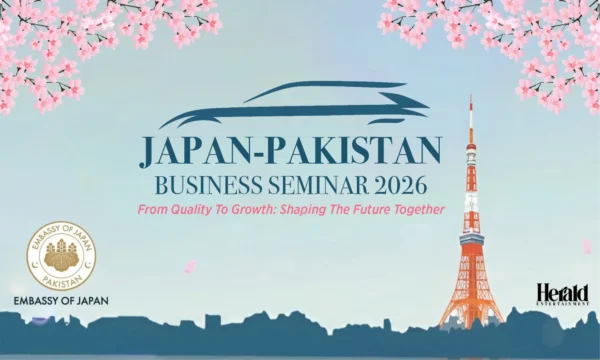
The Japan-Pakistan Business Seminar was held in Islamabad on February 10, bringing together senior government officials, diplomats, business leaders and development specialists to discuss the future direction of bilateral economic cooperation.
Hosted by the Embassy of Japan at the Serena Hotel, the seminar positioned Japan and Pakistan as long-term partners rather than transactional counterparts. Speakers stressed that sustainable growth depends on trust, policy continuity and shared strategic objectives rather than short-term commercial gains.
More information on Japan-Pakistan diplomatic engagement can be found at the Embassy of Japan in Pakistan website: https://www.pk.emb-japan.go.jp/itprtop_en/index.html
Lessons from Japan’s industrial experience
A major focus of the seminar was Japan’s post-war economic transformation and its relevance for Pakistan. Participants noted that Japan’s success was rooted in a consistent national vision as an export-oriented industrial economy supported by close coordination between government and the private sector.
Speakers emphasised that Pakistan’s growth prospects would benefit from long-term industrial policy centred on sectors where it holds a comparative advantage, including textiles, information technology, energy and manufacturing. Policy consistency and institutional predictability were described as essential to attracting both domestic and foreign investment.
Human capital as a growth engine
Education and workforce development featured prominently in the discussions. Japan’s sustained investment in science, mathematics, technical education and vocational training was cited as a key driver of productivity and innovation.
With one of the youngest populations in the region, Pakistan was described as being at a demographic crossroads. Participants argued that prioritising technical training and digital skills could help convert population growth into economic strength and improve competitiveness in global markets.
Technology absorption and productivity
Rather than focusing solely on technology imports, the seminar stressed the importance of technology absorption and continuous improvement. Japan’s kaizen philosophy which emphasises incremental innovation and process refinement was presented as a practical model for industrial upgrading.
Speakers noted that partnerships between Pakistani firms and Japanese companies could strengthen local manufacturing capabilities improve productivity and enhance resilience across supply chains.
Savings investment and financial stability
Another key theme was the role of savings and financial institutions in economic development. Japan’s experience of channelling household savings into productive corporate investment through a stable financial system was highlighted as a lesson for Pakistan.
Participants observed that a predictable regulatory environment and stronger financial intermediation could enable domestic capital to support long-term growth and reduce reliance on short-term external financing.
Trust social stability and governance
Trust between institutions businesses and society was described as a critical yet often overlooked factor in development. Speakers pointed to Japan’s corporate culture, where long-term labour management relations are supported by social stability and transparent legal frameworks.
For Pakistan, strengthening institutional credibility, political stability and rule of law was seen as essential to sustaining investor confidence and economic reform.
Trade cooperation and global integration
The seminar also examined Japan’s approach to international trade and cooperation. Speakers noted that Japan remains committed to multilateral trade systems, including the World Trade Organization and Economic Partnership Agreements, despite increasing global uncertainty.
Participants encouraged Pakistan to deepen economic ties with Japan while expanding engagement with regional and global markets. Enhanced trade cooperation was described as a pathway to diversification, technology transfer and export growth.
Automotive collaboration and market linkage
A significant area of discussion and bilateral engagement highlighted during the seminar was the Japanese automobile sector’s long-standing presence in Pakistan. Brands such as Honda Toyota and Suzuki dominate large segments of Pakistan’s passenger vehicle market through local manufacturing operations and joint ventures.
Honda Atlas Cars Pakistan has, in recent years, exported fully assembled vehicles to Japan, marking a notable shift from domestic assembly to export-oriented manufacturing. The development has been cited by industry observers as a sign of improving production standards and international confidence in Pakistan’s auto sector.
Toyota Indus Motor Company and Pak Suzuki Motor Company continue to play a central role in localisation vendor development and employment generation while Japanese vehicles remain highly sought after by Pakistani consumers for durability and resale value.
Official briefings referenced on Pakistan’s foreign ministry platform indicate that Japan and Pakistan have explored deeper industrial cooperation in automotive manufacturing and export-led growth, including policy dialogue on investment incentives and regulatory stability to encourage further Japanese investment.
A shared economic future
The seminar concluded with a reaffirmation of Japan and Pakistan’s shared interest in long-term partnership built on quality trust and mutual benefit. Speakers agreed that aligning policy, education, technology and trade could help shape a more resilient and sustainable economic relationship between the two countries.
Strengthening ties beyond the seminar
The business seminar took place against the backdrop of a broader period of diplomatic and economic activity between Tokyo and Islamabad. Japan and Pakistan recently celebrated 74 years of diplomatic relations with a networking event in Islamabad that emphasised economic cooperation, people-to-people links and cultural connectivity ahead of the seminar.
Bilateral mechanisms such as the 9th Japan-Pakistan High-Level Economic Policy Dialogue held in September 2025 in Islamabad reaffirmed commitment to coordinate on reform trade and investment while discussions in the 14th round of Bilateral Political Consultations reviewed cooperation across trade investment education and people-to-people exchanges.
Economic cooperation remains substantive, with Japan providing development assistance, technical cooperation and support for infrastructure and social projects across Pakistan. The Embassy of Japan’s news feed lists recent activities, including exchange programmes, grants and infrastructure initiatives that reflect ongoing partnership.
These developments show that the seminar formed part of a sustained diplomatic push to deepen bilateral engagement across economic, cultural and human capital dimensions and provide a platform for both countries to explore shared development priorities and future collaboration.