Pakistan, Kuwait agree to deepen economic, defense cooperation after ministerial talks
Arab News Pakistan
Published Date: July 29, 2026
Published On: Arabnews
Pakistan and Kuwait agreed on Wednesday to deepen cooperation across trade, investment, energy, labor, defense and other sectors while strengthening institutional ties through regular high-level exchanges, the foreign office said.
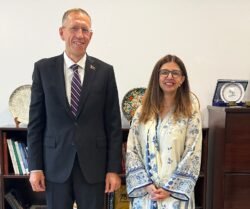
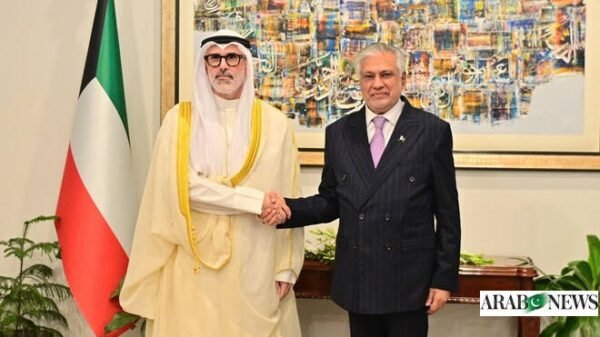
The statement follows delegation-level talks between Deputy Prime Minister and Foreign Minister Ishaq Dar and Kuwaiti Foreign Minister Sheikh Jarrah Jaber Al-Ahmad Al-Sabah in Islamabad in which both countries expressed their commitment to expanding a longstanding partnership beyond defense cooperation into broader economic engagement.
They also discussed close coordination on regional issues amid escalating conflict in the Middle East.
“The two sides reviewed the entire spectrum of Pakistan-Kuwait bilateral relations and discussed ways to further strengthen cooperation in trade, investment, energy, labor, agriculture, information technology, health, mining and minerals, defense, and the broader economic partnership,” Pakistan’s foreign ministry said after delegation-level talks between Dar and Al-Sabah.
“They agreed to further institutionalize bilateral cooperation through enhanced institutional linkages and regular high-level exchanges.”
The talks came days after Kuwait ratified a five-year defense cooperation agreement with Pakistan that establishes a framework for collaboration in military training, intelligence sharing, logistics, defense technology, scientific research and joint exercises. The agreement, originally signed in 2023, also provides for cooperation in military manufacturing and establishes a joint committee to oversee its implementation.
The ratification follows months of high-level contacts between Pakistani and Kuwaiti civilian and military officials and comes after heightened security tensions in the Gulf, where Kuwait has faced Iranian missile and drone attacks during recent regional hostilities.
Beyond bilateral cooperation, the ministers also reviewed developments in the Middle East, where Pakistan has emerged as a key diplomatic interlocutor in efforts to reduce tensions between the United States and Iran.
Pakistan’s diplomatic role expanded after it hosted unprecedented US-Iran talks in Islamabad in April, which culminated in the signing of the Islamabad Memorandum of Understanding in June. The interim agreement called for a ceasefire, the reopening of the Strait of Hormuz to commercial shipping and a framework for broader negotiations.
The agreement was followed by high-level and technical talks in Bürgenstock, Switzerland, where US and Iranian representatives, with Pakistan and Qatar serving as mediators, adopted a 60-day roadmap toward a final settlement covering sanctions, Iran’s nuclear program and maritime security in the Gulf.
However, Pakistan’s mediation efforts have come under increasing pressure since the United States and Iran resumed military strikes this month, effectively derailing much of the progress made under the Islamabad Memorandum. The renewed fighting has included Iranian missile and drone attacks on US military bases in the Gulf and retaliatory US strikes on Iranian military targets, while Iran-backed Houthi fighters have stepped up attacks on shipping in the Red Sea and recently announced a maritime blockade targeting Saudi vessels, widening the regional conflict.
Amid these developments, Islamabad has remained engaged with regional and international partners, including Saudi Arabia, Oman, Kuwait, China and Qatar, as part of broader diplomatic efforts to sustain dialogue between Washington and Tehran and prevent further escalation. Pakistan has also maintained contacts with Iranian officials as it seeks to revive the mediation process following the collapse of the earlier ceasefire.
“The two sides also exchanged views on regional and international developments of mutual interest, including the situation in the Middle East and Palestine,” the foreign ministry said.
“The Kuwaiti Foreign Minister also appreciated Pakistan’s constructive role in promoting regional peace and stability.”