Ministry of Finance’s economic update: reading past headlines

Publishing date: 06 January 2026
Published in: Business Recorder
The Ministry of Finance’s (MoF’s) Monthly Economic Update & Outlook describes what it sees as a recovering economy, underpinned by moderating inflation, improving fiscal balances, and quarterly GDP growth of 3.7 percent driven by broad-based recovery across the real economy.
Read at face value, the numbers suggest a system regaining momentum after a difficult period. The underlying data, however, tells a more restrained story.
Recall that the quarter now being celebrated included flood-linked crop losses, officially highlighted by the government itself as evidence of large-scale impact of climate damage.
Several major kharif crops underperformed against last fiscal year, according to already published SBP and FCA estimates, while livestock price inflation remains materially stronger than the long-run trend.
As per the ministry’s own disclosures, DAP fertilizer offtake also fell by over 16 percent against the same period last year. Despite these conditions, agriculture GDP is now reported to have grown by 2.9 percent during Q1 FY26.
While the national accounts statistics claim a year-on-year growth of 6.3 percent in livestock, the fact remains that a sharp increase in prices alongside constrained household purchasing power is more indicative of supply strain than of strong livestock output.
Beef, mutton and fresh milk prices have risen substantially faster than the rest of the food basket over the last two years. Similarly, reduced fertilizer intensity is typically a leading indicator of weaker yields, not stronger value-added. Farmers scale back nutrient application when margins are thin, liquidity is tight or risk is elevated.
It is difficult, therefore, to reconcile falling fertilizer use, elevated livestock prices and reported flood damage with the Ministry’s claim of broad-based strength in agriculture GDP.
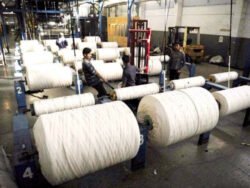
This pattern is repeated elsewhere in the update. Industry is described in similarly upbeat terms. Quarterly GDP statistics show industrial growth of 9.4 percent in Q1 FY26, supported in part by large-scale manufacturing. Here, too, context matters.
Manufacturing output had already contracted heavily in prior years and was operating from a depressed base. As import restrictions ease and inventories normalise, a rebound is mechanically likely. That rebound is real, but it reflects normalisation, not a decisive structural shift.
Meanwhile, the GDP accounts also show electricity, gas and water reporting growth above 20 percent. This sits uneasily alongside tariff-led demand compression, affordability stress, circular debt concerns and stagnant system-wide consumption indicators.
Services tell a related story. Finance and insurance GDP is reported to have grown by over 10 percent. Yet private sector credit has been broadly range-bound since early 2025, ADR ratios are near historic lows, and banks continue to borrow from SBP in OMOs (open market operations) to invest in government securities. A genuine expansion in financial services value-added should typically coincide with stronger private intermediation, rising long-term credit and deeper product penetration. Those conditions are not yet visible in reported data.
The picture painted on inflation follows a similar pattern. Headline CPI has indeed moderated compared to last year’s peak. But the ministry’s update pays less attention to a more meaningful indicator: core inflation. Core inflation, excluding volatile food and energy components, remains elevated and has not yet returned to the SBP’s medium-term target range of 5 to 7 percent. In both urban and rural segments, NFNE (non-food non-energy) core inflation has been stuck well above this range throughout 2025.
This distinction matters. The bulk of the decline in headline CPI over the past year has been driven by base-effect correction and earlier easing in food and energy prices, not by a broad-based softening in underlying price or demand side pressures. As those base effects now roll off entering 2026, the statistical drag that pulled headline inflation down will begin to fade. In that environment, persistently high core inflation leaves little comfort that Pakistan has fully anchored price stability.
In practical terms, this means the household cost structure remains tight even if the headline number looks improved. Prices in categories such as milk, meat, education, health and services continue to behave in a sticky fashion. These are the categories that dominate everyday spending for most urban and rural families. A durable easing in inflation would require core inflation to settle within target and to stay there. That has not yet happened.
On the fiscal front, consolidated accounts are reported to be in surplus in the first quarter of FY26. On paper, that is encouraging. But a closer look at the composition shows that much of this improvement is driven by extraordinary non-tax receipts, most notably profit transfer from the SBP, alongside petroleum levy collections and provincial cash surpluses. These flows lift the quarterly balance, but two years into the Fund programme there are still no signs of broad-based strengthening in the tax base or structural spending reform.
On the expenditure side, underlying pressures remain unchanged. Interest expense is still elevated in level terms, development spending remains structurally subdued, and outlays such as pensions, subsidies and loss-making public enterprises have not materially adjusted. In that sense, the fiscal balance looks better than last year, but largely because of one-off inflows and IMF-directed restraint rather than durable consolidation. The year-on-year improvement may be real, but it is less clear that it represents a permanent shift in Pakistan’s fiscal trajectory.
For the last three years, the distinction between stabilisation and growth has been important. Stabilisation was necessary when the country stood on the brink of default, but it cannot be the end state. That does not mean the government should now embark on an expansionary spree to engineer growth at all costs. What it does mean, however, is that the focus must gradually shift from crisis management to tackling the structural weaknesses that keep growth fragile.
The Monthly Economic Update will naturally present the fiscal authorities’ perspective. But beyond reporting monthly outturns, the publication could play a more constructive role if it also set out, clearly and consistently, the steps being taken to address the structural constraints that still define Pakistan’s economy. That would shift the conversation from self-assessment to strategy.
The headline numbers may be improving, but the task ahead remains the same: broadening the tax base, reforming state-owned enterprises, rationalising subsidies, improving energy and regulatory efficiency, and supporting private investment and productivity. Progress on these substantive fronts, rather than commentary on monthly food prices, will ultimately determine whether stabilisation evolves into sustainable growth.